SBT
AI, Fries, and the Secret Sauce of Belief and Execution (a.k.a. The RAD Factor)
AI, Fries, and the Secret Sauce of Belief and Execution (a.k.a. The RAD Factor)
By Dr. Héctor Gómez Macfarland
Abstract
In a world where artificial intelligence and fast food somehow share the same headlines, the secret to business success isn’t just code or calories — it’s belief and execution.
This fun story-driven article introduces the Risk-Adjusted Differential (RAD) — a simple way to measure the gap between what people believe about a company and what it actually delivers. From NVIDIA’s AI hype to McDonald’s golden consistency, this article blends business strategy with humor, showing that whether you’re frying fries or fueling AI, survival depends on balancing belief and execution.
Fries, Phones, and Futures
Imaging you’re sitting at McDonald’s with fries in one hand and your phone in the other, doom-scrolling through AI memes. One post says, “AI will take your job.” The next says “AI just wrote a breakup song better than Taylor Swift.”
Meanwhile, you’re still waiting for your McFlurry machine to work.
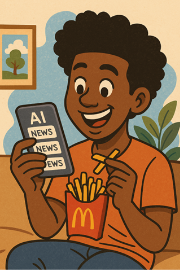
Figure 1. When Fries Meet Futures — The New Face of the AI Economy
Congratulations — you’ve just experienced the entire global economy in one sitting. On one side, you’ve got fries: predictable, comforting, crispy. On the other, you’ve got AI: powerful, mysterious, occasionally broken. But both are powered by something you can’t taste or touch — belief and execution.
The Invisible Sauce: Belief and Execution
Let’s start with McDonald’s. Nobody visits for culinary surprises. We go because we know exactly what we’re getting — fries that taste the same in Texas, Tokyo, or Timbuktu. That’s not just supply chain excellence; that’s psychological comfort. McDonald’s doesn’t sell potatoes; it sells predictability.
Now, meet NVIDIA — the world’s most valuable company as of October 2025, worth a staggering $4.47 trillion USD. It designs the hardware and software that powers artificial intelligence, from datacenters to your gaming laptop. Its magic isn’t just in the chips; it’s in the promise. NVIDIA sells the dream that your computer might soon outsmart you — and, at the very least, make your video games look so real that even the hair moves like it just dropped a dance challenge.
In every case, belief turns ordinary firms into cultural icons. The trick is knowing how much of that belief is deserved.
When Bots Meet Business
Every company runs not only on what it makes — chips, burgers, apps — but also on intangibles: trust, culture, story, timing, and execution. Those invisible assets are what make brands survive recessions and memes alike. But how do you measure belief and execution?
That’s where RAD comes in — short for Risk-Adjusted Differential.
Originally inspired by Professor Victor J. Cook Jr.’s 2003 study at the Marketing Science Institute, the RAD idea was expanded by Professor Dr. Héctor Gómez-Macfarland into a modern tool for understanding how belief and performance shape success in the AI era.
In plain English, RAD = the difference between how much the world believes in you (your value share, SOV) and how much you actually sell (your revenue share, SOR).
If belief outpaces performance → High RAD (people think you’re the next big thing).
If sales outpace belief → Low RAD (you’re underrated — or boring).
If they’re balanced → Sustainable RAD (you’re McDonald’s).
RAD is basically the ultimate business vibe check.
Visualizing RAD with the Matrix
Now that we know how to calculate RAD, the next question is how to see it. Numbers are useful, but patterns tell the real story. That’s where the RAD Matrix comes in — a visual way to map belief, performance, and sustainability.
Think of the RAD Matrix as the “vibe detector” of the business world. It shows how much a company’s story (its brand, leadership, vision, and reputation) lines up with its strategic momentum (its execution results, such as growth and profits).
The AI Hype Squad
Let’s see how this plays out in the semiconductor playground.
NVIDIA doesn’t just sell chips, a trusted innovator — it sells certainty. Its GPUs are the holy relics of the AI era. Its RAD is sky-high because investors believe it’s building the infrastructure of the future, with good execution results. It’s like that one classmate who brags — and actually delivers.
AMD is the smart kid everyone roots for, a visionary storyteller. Great tech, great story — but still waiting for full recognition. RAD = belief in layaway.
Broadcom? The quiet achiever, a reliable executor. Keeps the internet running while others chase headlines. Low RAD, high reliability. The corporate equivalent of a friend who’s “just chill.”
Intel, on the other hand… was once the prom king, a fading narrative. Now he’s telling you about his past glory days. Big revenue, small RAD. The story doesn’t match the stats.
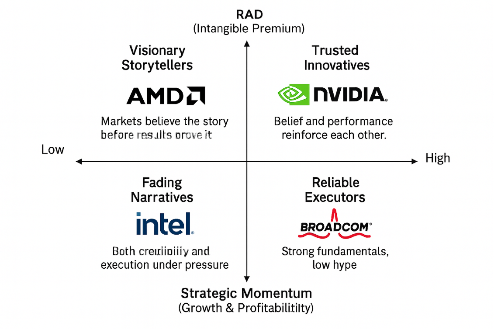
Exhibit 1. The Silicon Showdown: Who’s Got the RAD in AI?
RAD reveals who’s living their legend and who’s just coasting on memory.
The Burger Believers
Now, jump from silicon to salt.
McDonald’s is the Trusted Innovator— belief meets execution. It’s not just burgers; it’s cultural stability in a paper wrapper.
Chipotle? The Reliable Executor. Clean, fast, responsible — burritos that never crash. Belief is growing, but hype still has guac to catch up on.
Wendy’s and Popeyes? Fading Narratives. People like the food but don’t tweet about it. Consistency without excitement.
Yum! Brands (Taco Bell, KFC, Pizza Hut) sits there losing strategic momentum —global, but not revolutionary. Nobody’s making a documentary about it yet.
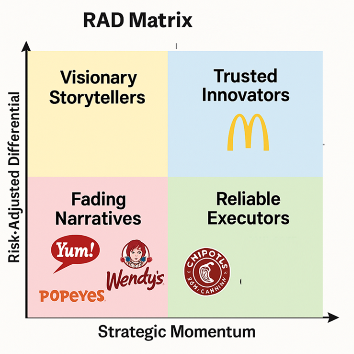
Exhibit 2. Who’s Frying, Who’s Fading: The RAD Map of Fast Food
Here’s the kicker: no fast-food brand sits in the Visionary Storyteller zone — the place where storytelling meets belief.
That’s a strategic white space — the “AI & Fries” frontier, because the future of fast food (and business) isn’t only about who serves the fastest fries — it’s about who serves the best story, with receipts to back it up.
The RAD Recipe (Life Hack)
RAD isn’t just a number — it’s a mirror.
For students:
Your grades/GPA are your SOR (what you do).
Your reputation is your SOV (what others expect).
Your RAD is the gap between them.
If SOV > SOR → people believe in you.
If SOV < SOR → you’re working hard but need to tell your story better (better personal branding).
So, whether you’re building your GPA or your startup, keep your RAD balanced — belief earns your opportunities, execution keeps them.
The RAD Takeaway: Belief, Burgers, and a Side of AI
Over in tech land, it’s the same recipe — just cooked with different chips.
NVIDIA’s investors think they’re watching the next industrial revolution; Intel’s look like they’ve heard that pitch before. That gap between belief and proof? That’s RAD in action.
McDonald’s doesn’t just sell fries; it sells faith. Investors trust that those golden arches will keep glowing through recessions, TikTok trends, and the occasional “ice-cream machine is down” meltdown. That’s classic high RAD — belief earned through decades of consistency, culture, and ketchup.
Wendy’s still makes great burgers (and even better roasts on X), but its story doesn’t sizzle quite the same. It’s the sequel everyone enjoys but few quote — low RAD, strong execution, weaker narrative.
In the end, whether you’re coding the next chatbot or flipping the next Big Mac, the secret sauce isn’t just data or ketchup — it’s belief mixed with execution.
NVIDIA and McDonald’s may live in different worlds, but they share the same formula: trust, timing, and delivery.
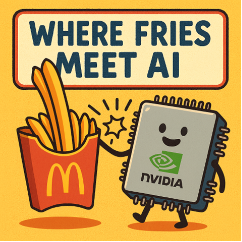
Because in business (and life), success lives right where fries meet AI — and where belief finally meets execution